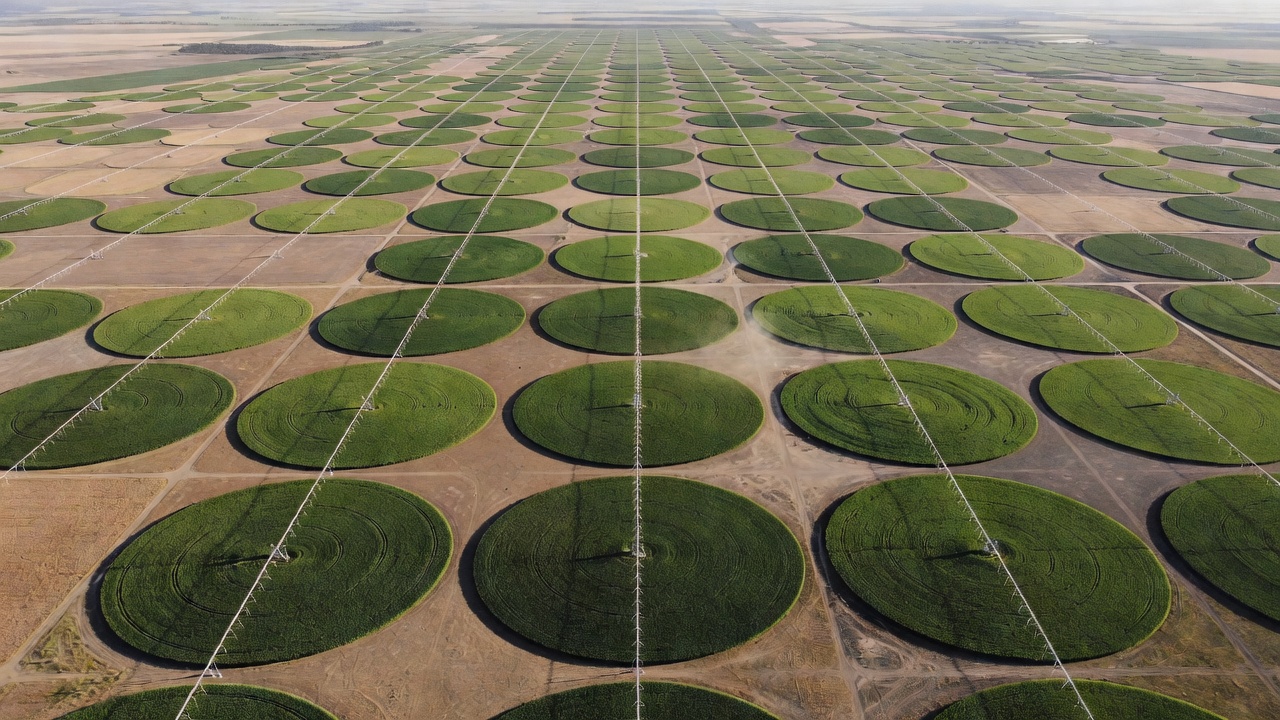
Water scarcity and increasing regulatory pressures regarding water extraction are pushing agricultural operations away from traditional, inefficient flood irrigation toward highly controlled, mechanized systems. Modern irrigation technology is designed to maximize the "crop per drop," applying water precisely where and when the plant needs it, with minimal loss to wind drift or evaporation.
Center Pivot Irrigation
The center pivot is the defining visual of modern large-scale agriculture. These systems consist of a long span of pipe supported by wheeled A-frame towers. Water is pumped up through a central pivot point, and the entire structure rotates slowly in a circle.
Pivots are favored for their automation and reliability over large areas. However, because the outer towers have to cover a much larger circumference than the inner towers, the nozzles must be carefully sized. The nozzles near the pivot point emit a small spray, while the nozzles at the far end must deliver a massive volume of water to ensure even coverage across the field. Modern pivots often use drop hoses (LEPA - Low Energy Precision Application) to bring the sprinkler heads down directly into the crop canopy, drastically reducing evaporation.
Lateral Move (Linear) Systems
Mechanically similar to center pivots, lateral move systems do not anchor to a central point. Instead, the entire line of towers moves straight down a rectangular field. They draw water either from an open ditch running alongside the field via a suction hose or through a flexible drag hose attached to pressurized hydrants.
Lateral moves provide excellent, highly uniform coverage and can irrigate 98% of a square field, avoiding the unwatered corners inherent to circular center pivot setups. However, they require more complex guidance systems (using furrow tracking, buried wire, or GPS) and are generally more labor-intensive to manage due to hose dragging and repositioning.
Subsurface and Surface Drip Irrigation
Drip irrigation represents the pinnacle of water efficiency. In these systems, thin polyethylene tubing with regularly spaced emitters is laid directly on the soil surface or buried a few inches underground in the root zone.
Water is pumped through the lines at low pressure, slowly dripping directly into the soil. Because there is no aerial spray, wind drift and surface evaporation are virtually eliminated, pushing application efficiency near 98%. Drip systems also allow for highly efficient "fertigation"—the injection of liquid fertilizers directly into the irrigation water, delivering nutrients right to the roots.
The main drawbacks to drip irrigation are the high initial installation cost, the vulnerability of surface lines to rodent damage, and the requirement for extensive filtration systems to prevent the tiny emitters from clogging with particulate matter or algae.
Telemetry and Scheduling
Regardless of the delivery method, modern irrigation relies heavily on telemetry. Soil moisture probes buried at various depths transmit data via cellular networks back to the farm manager's dashboard. Advanced software analyzes this data alongside local weather forecasts to predict evapotranspiration rates, automatically turning pivots or drip pumps on only when the soil moisture drops below a specific threshold. This data-driven scheduling prevents over-watering, saving energy costs, conserving water, and preventing nutrient leaching.