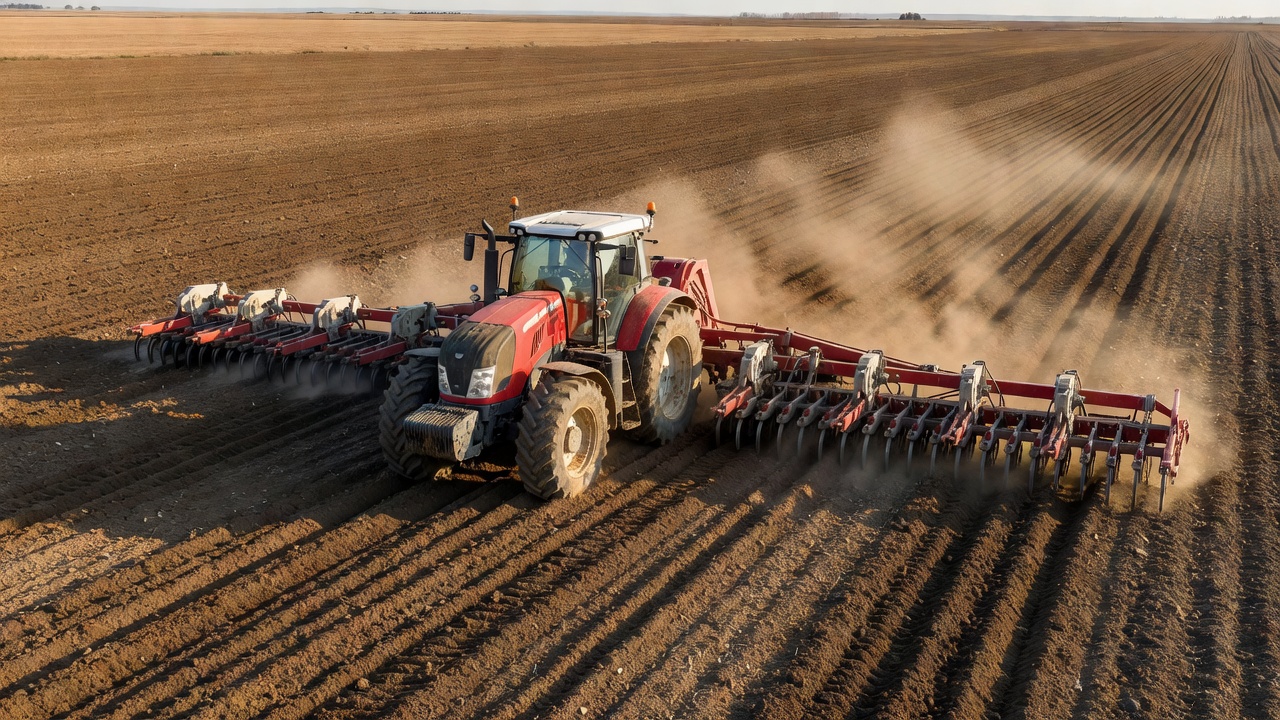
The foundation of a successful harvest is laid on planting day. Poor seed placement—whether too shallow, too deep, or unevenly spaced—directly restricts yield potential before the crop has even emerged. Modern seeding equipment leverages remarkable technology to ensure uniform emergence across highly variable field conditions.
Planters vs. Seed Drills
Equipment choice depends entirely on the crop being sown:
- Precision Planters: Used primarily for row crops like corn, soybeans, cotton, and sunflowers. Planters are designed for absolute precision. They meter out individual seeds at highly specific intervals within the row (singulation).
- Seed Drills and Air Seeders: Used for small grains like wheat, barley, oats, and canola. Rather than spacing seeds individually, drills dispense seed volumetrically in narrow rows (often 6 to 10 inches apart). Air seeders use pneumatic tubes to blow seed from a large central commodity cart out to a wide implement toolbar, allowing for massive working widths and fewer stops to refill.
The Mechanics of Precision Planters
The row unit is the heart of a precision planter. It performs several consecutive actions in a fraction of a second:
- Residue Management: Row cleaners sweep aside previous crop residue to expose bare soil.
- Trenching: Double-disc openers slice a precise V-shaped trench into the soil.
- Singulation and Delivery: A vacuum or positive-air metering system picks up individual seeds on a rotating disc. As the disc turns, the vacuum is cut off precisely over the seed tube, allowing the seed to drop down into the trench. Advanced high-speed planters use a brush belt instead of a gravity tube to physically carry the seed down to the trench, eliminating the "bounce" that disrupts spacing at high speeds.
- Closing: Angled closing wheels pinch the trench shut and firm the soil around the seed to trap moisture.
Downforce and Depth Control
Consistent depth is paramount. If seeds are planted at varying depths, they will emerge at varying times. Late-emerging plants are treated as weeds by their neighbors, losing the competition for sunlight and nutrients.
Maintaining constant depth requires downforce. Historically, this was achieved via heavy mechanical springs on each row unit. Today, precision planters use active hydraulic or pneumatic downforce systems. Sensors read the resistance of the soil in real-time, and a controller adjusts the pressure applied to each individual row unit multiple times per second. If a row unit hits a hard patch of compacted soil, the system instantly increases downward pressure to keep the disc openers at the target depth.
Variable Rate Technology (VRT)
Fields are rarely uniform. Soil types, organic matter, and moisture-holding capacity vary wildly even within a single hectare. Variable Rate Technology (VRT) allows the planter to change the seeding population on the fly based on GPS prescription maps. In highly fertile zones, the planter drops more seeds to maximize yield. In sandy, less productive zones, the planter reduces the seeding rate, saving expensive seed that the poor soil would not be able to support anyway.